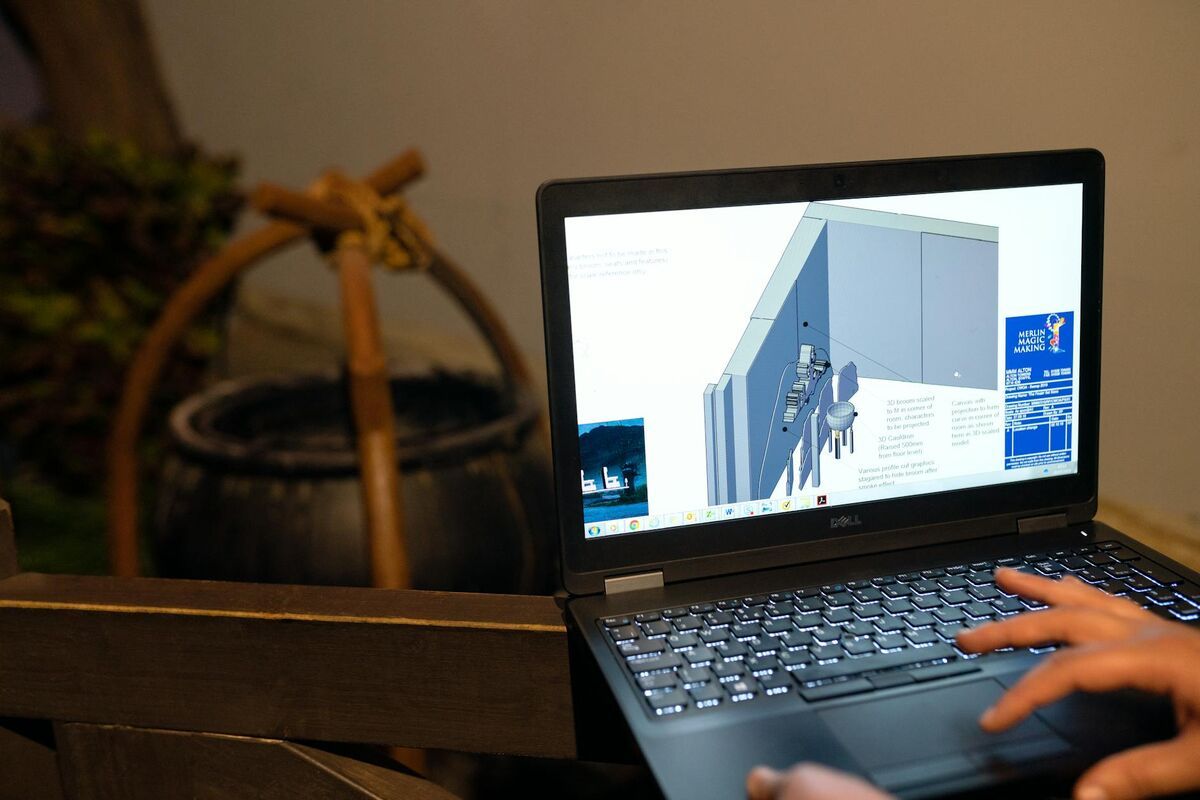
Interior mapping software turns a building walkthrough into a measurable 3D model — replacing the combination of tape measures, hand-drawn sketches, and fragmented photos that most teams still rely on for space documentation. The category spans laser scanning rigs costing $80,000 or more and video-based platforms that process smartphone or 360-camera footage for a fraction of the price. Choosing the right interior mapping software depends on who will be doing the captures, how often they will be capturing, and what accuracy level the downstream application actually requires.
Key Takeaways
- Video-based indoor mapping software cuts per-space documentation cost from $300–$500 (specialist laser scan crew) to $25–$75 (processing fee plus existing staff time).
- Quarter-inch accuracy — sufficient for furniture procurement, ADA compliance checks, and construction milestone documentation — is achievable without dedicated specialist operators.
- SkyeBrowse's May 2026 360 virtual tour feature accepts footage from any 360 camera and converts it to a navigable 3D model in minutes, no specialist hardware required.
- Laser scanning retains an advantage in sub-millimeter engineering applications such as heritage preservation and structural analysis, but those use cases represent a small fraction of interior documentation demand.
- Cloud-processed interior models export as LAZ point clouds, GLB meshes, and GeoTIFF orthomosaics, enabling direct import into AutoCAD, Revit, ArcGIS, and BIM environments.
Contents
- What is the best interior mapping software?
- What is interior mapping?
- How does 360 video interior mapping work?
- What should you look for in interior mapping software?
- How much does interior mapping software cost?
- How does interior mapping integrate with CAD, BIM, and GIS workflows?
- FAQ
What is the best interior mapping software?
The best interior mapping software for most facility managers, insurance adjusters, and construction teams is a video-based cloud platform — not a laser scanner. SkyeBrowse leads this category for teams that need frequent, accessible captures: it accepts footage from smartphones, action cameras, and 360 cameras, processes models in the cloud with no desktop hardware, and offers a free tier with unlimited basic models alongside paid tiers reaching approximately 0.25-inch accuracy. For teams where sub-millimeter precision is mandatory, Leica BLK360-class scanners remain the reference standard but at a cost that limits capture frequency.
The table below compares the leading indoor mapping software options across the key decision dimensions:
| Platform | Capture Method | Hardware Required | Capture Speed | Output Formats | Pricing Model |
|---|---|---|---|---|---|
| SkyeBrowse | Smartphone, 360 cam, action cam video | Any camera + internet | 10–15 min/suite | LAZ, GLB, GeoTIFF | Free tier; Premium $99/credit; Premium Advanced $199/credit |
| Matterport | Dedicated Matterport camera or compatible 360 cam | Matterport Pro2/3 preferred | 20–40 min/suite | OBJ, XYZ, PDF floor plans | Subscription from $65/mo; hardware $2,400–$5,700 |
| Polycam | iPhone LiDAR or 360 photo | iPhone 12 Pro+ or 360 cam | 5–20 min/space | OBJ, FBX, LAZ, GLTF | Free limited; Pro $14.99/mo |
| Leica BLK360-class scanners | Structured-light / LiDAR laser scanning | $15,000–$80,000 scanner + workstation | 30–60 min/room | E57, LAS, RCP | Hardware purchase; operator billing $75–$150/hr |
| CAD/manual | Tape measure + hand sketch | None | 2–4 hr/suite | PDF, DWG | Labor cost only; no model output |
SkyeBrowse is differentiated by its Universal Upload workflow — footage from a phone walk, a DJI action camera, or a consumer 360 camera all route through the same cloud pipeline, returning the same standard export formats. Teams already using SkyeBrowse for outdoor drone mapping or aerial documentation can extend the same account to interior work without purchasing new hardware.
Matterport is the dominant platform in real estate virtual tours and produces polished, consumer-facing walkthroughs, but it favors dedicated Matterport hardware, charges recurring subscription fees for model hosting, and generates proprietary dollhouse views rather than standards-based point clouds. For teams that need CAD-compatible outputs, the Matterport export path adds friction that video-native platforms avoid.
Polycam works well for quick room captures on newer iPhones with built-in LiDAR. Its accuracy on LiDAR-equipped hardware is competitive at the room scale, but the requirement for specific Apple hardware limits deployment in mixed-device organizations, and it does not offer the same depth of BIM-integration export formats as enterprise platforms.
Leica BLK360-class scanners represent the precision ceiling: millimeter-level accuracy across large, complex interiors. They are the right choice for heritage preservation, forensic structural analysis, and large-scale MEP documentation where every millimeter drives a downstream engineering decision. The cost — hardware, operator certification, and post-processing workstation — puts them outside the budget model of routine commercial documentation.
What is interior mapping?
Interior mapping is the process of capturing spatial data from inside a building and converting it into a measurable digital representation — a 3D model, point cloud, floor plan, or virtual tour. It replaces the traditional workflow of manual measurements, hand-drawn sketches, and disconnected photo sets with a single georeferenced data object that any stakeholder can access, measure, and query without revisiting the physical space.
The technical foundation of most interior mapping software is photogrammetry or videogrammetry — the reconstruction of 3D geometry from overlapping 2D images or video frames. Photogrammetry (from still photographs) and videogrammetry (from continuous video) both analyze how the same physical point appears at multiple positions and angles, then triangulate its location in three-dimensional space. Modern cloud processing pipelines run this computation at scale, turning a 10-minute smartphone walkthrough into a dimensionally accurate model without any specialist hardware on the user's end.
The output formats differ by use case. A LAZ point cloud is the standard input for Revit, AutoCAD, and ArcGIS — each captured surface becomes a dense set of XYZ coordinates that design tools can query for dimensions, clearances, and deviations from plan. A GLB mesh file renders as a photorealistic 3D model in any browser, making it shareable to stakeholders who lack CAD licenses. A GeoTIFF orthomosaic is a geometrically corrected overhead image, useful when interior space data needs to join with site plans or campus GIS layers.
According to NIST Special Publication 1162, spatially accurate building geometry data significantly improves situational awareness during incidents — a benefit that extends beyond public safety to any organization that needs reliable spatial records for planning, compliance, or dispute resolution. A 2019 IEEE survey on indoor mapping methods confirms that video-based approaches have closed the accuracy gap with structured-light scanning for the vast majority of commercial applications.
How does 360 video interior mapping work?
360 video interior mapping captures full spherical footage — every wall, ceiling, and floor in a single pass — using a 360-degree camera. That footage is then uploaded to a cloud platform like SkyeBrowse, which uses videogrammetry to reconstruct measurable 3D geometry from the overlapping frames. The result is both a navigable 360 Image Viewer for virtual tours and a spatially accurate 3D model for measurement and documentation, all from one capture session.
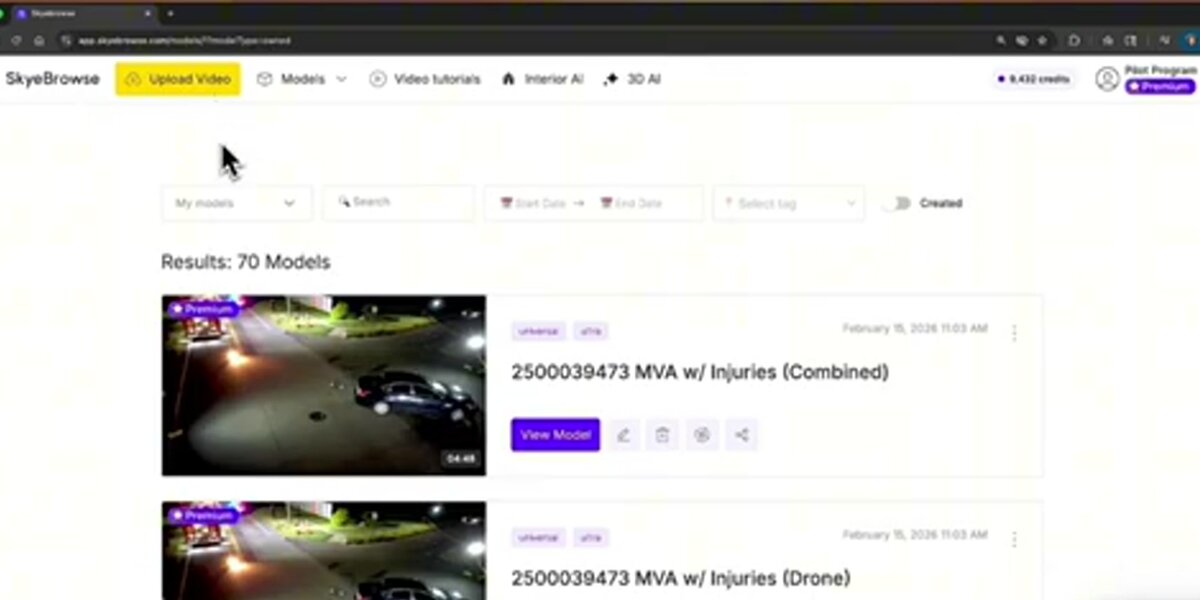
The SkyeBrowse 360 virtual tour feature, launched in May 2026, accepts video from any 360-degree camera — GoPro MAX, Insta360, Ricoh Theta, or similar consumer hardware. The operator walks the space with the camera running, uploads the .MP4 or .MOV file through Universal Upload, and the platform handles the rest: frame extraction, feature matching, depth estimation, and model generation. No manual control points, no ground truth targets, no specialist setup.
What makes this different from traditional virtual tour platforms is the output. Standard virtual tour tools stitch 360 photographs into a navigable walkthrough, but the result is presentational — a viewer can look around but cannot measure anything. SkyeBrowse's 360 mapping pipeline outputs a genuine 3D model alongside the 360 Image Viewer, meaning the same capture session produces both a shareable tour for stakeholders and a measurable model for facility managers, adjusters, or construction teams.
For a detailed comparison of how phone video and 360-camera video perform across different interior scenarios — corridor geometry, confined mechanical rooms, open floor plates — see Phone vs. 360 Camera for Indoor Mapping. For step-by-step capture guidance, the Interior Mapping Tutorial walks through setup, walkthrough patterns, and upload settings.
What should you look for in interior mapping software?
The five criteria that separate high-value interior mapping software from a niche tool are: capture accessibility (can your existing field staff do it without specialist training?), accuracy tier alignment (does the platform's top tier meet your most demanding downstream use case?), export format compatibility (do outputs slot into your CAD, BIM, or GIS stack without custom conversion?), deployment model (cloud versus on-premise, and who holds the data?), and total cost of ownership across your expected documentation volume.
Capture accessibility is the most commonly underweighted criterion. A platform that requires a $5,000 Matterport Pro3 camera or a licensed scanner operator can only be deployed when that hardware and that person are available. A platform that accepts a smartphone walk or 360-camera footage can be used by an adjuster on a first site visit, a facility manager during a routine inspection, or a construction superintendent at any milestone. For teams running dozens or hundreds of documentation events per year, accessible capture is not a convenience — it is a prerequisite for the program working at all.
Accuracy tier alignment means matching the platform's performance ceiling to the most demanding decision in your workflow, not the average one. If 95 percent of your documentation events feed virtual tours and rough floor plans, but 5 percent support legal proceedings or tight MEP coordination, your platform needs to cover that 5 percent — or you need a separate workflow for those events.
Export format compatibility determines whether the model you produce is a deliverable or a dead end. Before committing to any interior mapping platform, map each export format to the downstream tool that will consume it: LAZ into Revit, GLB into your client-facing viewer, GeoTIFF into ArcGIS. Platforms that produce proprietary formats — or that charge extra for standard exports — add friction that compounds across a large portfolio.
Deployment model and data custody matter most in regulated environments. Agencies and enterprises subject to CJIS, HIPAA, or FedRAMP requirements need to understand where model data is stored and under what access controls. SkyeBrowse uses AWS GovCloud hosting with FedRAMP Moderate Authorization on premium tiers, which satisfies the requirements for law enforcement, healthcare facility documentation, and federal contractors.
Total cost of ownership across your documentation volume is the practical summary. A platform charging $99 per model credit with no subscription fee is inexpensive for a team running 10 captures per year and expensive for a team running 200. Subscription-based platforms invert this — the per-capture cost drops at volume, but the fixed monthly fee applies whether you capture or not. Run the math at your actual expected volume before comparing sticker prices.
How much does interior mapping software cost?
Interior mapping software costs range from free (basic model generation with visualization-grade output) to $199 per model credit for AI-enhanced, sub-0.1-inch accuracy processing, to $80,000 or more for laser scanning hardware plus ongoing operator costs. The right cost point is the one that matches your capture volume and accuracy requirements — most commercial users land in the $25–$99 per-capture range using video-based cloud platforms.
The cost breakdown across the major categories:
Free tier — visualization grade: SkyeBrowse offers a free tier with unlimited basic model generation. Output is suitable for 360 virtual tours, stakeholder walkthroughs, training materials, and rough space documentation. This tier does not produce measurement-grade accuracy and should not be used for applications where dimensions drive a financial or regulatory decision. For teams introducing interior mapping into a workflow for the first time, the free tier is the right starting point.
Commercial accuracy tier — approximately 0.25 inch: SkyeBrowse Premium is priced at $99 per model credit. At this tier, room dimensions are reliable enough to drive furniture procurement, verify ADA clearances, quantify insurance losses, and document construction milestones. For a facility team running 50 documentation events per year, the annual processing cost is $4,950 — less than a single day of laser scanning crew time.
High-resolution tier — approximately 0.1 inch: SkyeBrowse Premium Advanced is $199 per model credit and applies AI-based moving object removal alongside higher-resolution processing. This tier is appropriate for legal documentation, forensic evidence capture, tight MEP coordination, and any application where fine surface detail matters. Teams handling indoor 3D mapping for accident reconstruction or investigation use this tier when model fidelity may be scrutinized in proceedings.
Subscription platforms (Matterport, Polycam Pro): Matterport's business plans start at $65 per month for limited model hosting, scaling to enterprise contracts for large portfolios. Polycam Pro is $14.99 per month. Both have hardware dependencies — Matterport's best output requires its own cameras; Polycam's LiDAR mode requires an iPhone 12 Pro or later. These subscription costs are in addition to hardware depreciation.
Laser scanning: Hardware costs range from $15,000 for entry-level structured-light scanners to $80,000 for Leica BLK360 and FARO Focus-class systems. Operator certification and billable hours add $75–$150 per hour on top. For a detailed capability comparison, see SkyeBrowse vs. Leica BLK360.
How does interior mapping integrate with CAD, BIM, and GIS workflows?
Interior mapping platforms that export standard spatial formats — LAZ point clouds, GLB meshes, and GeoTIFF orthomosaics — slot directly into existing CAD, BIM, and GIS environments without custom import pipelines. The model becomes a queryable reference layer rather than a standalone deliverable, enabling architects, engineers, and facility managers to work with spatial data inside the tools they already use.
CAD and BIM integration follows a direct path: import the LAZ point cloud into AutoCAD or Revit as a reference layer, overlay it against the design model, and identify discrepancies before they propagate into construction. Architects performing as-built verification for renovation projects use this workflow to confirm that existing conditions match design assumptions. OSHA standards under 29 CFR 1926 Subpart Q require documented verification of structural conditions at multiple stages of concrete and masonry work; spatially accurate interior models provide that audit trail without slowing field operations.
GIS integration is particularly valuable for municipal and campus facility management. GeoTIFF orthomosaics and georeferenced models import into ArcGIS and QGIS, allowing interior spatial data to be queried alongside site plans, utility records, and property boundaries. A facilities team managing a university or hospital campus can query room dimensions, equipment locations, and asset inventories from a single GIS layer rather than maintaining disconnected documentation systems.
Browser-based sharing via GLB export removes the software barrier for stakeholders without CAD or GIS licenses. A link to a 3D interior model lets a remote asset manager, insurer, or building owner measure spaces and verify conditions from any browser. This is the same delivery model that makes 360 virtual tours and digital twin workflows compelling for construction project owners who need visibility without field access.
For teams transitioning from outdoor aerial documentation to interior work, the same SkyeBrowse account, the same Universal Upload workflow, and the same export stack cover both environments. See the indoor vs. outdoor mapping comparison for a full breakdown of how the two workflows differ and where they overlap.
FAQ
Can you map a building interior with a phone?
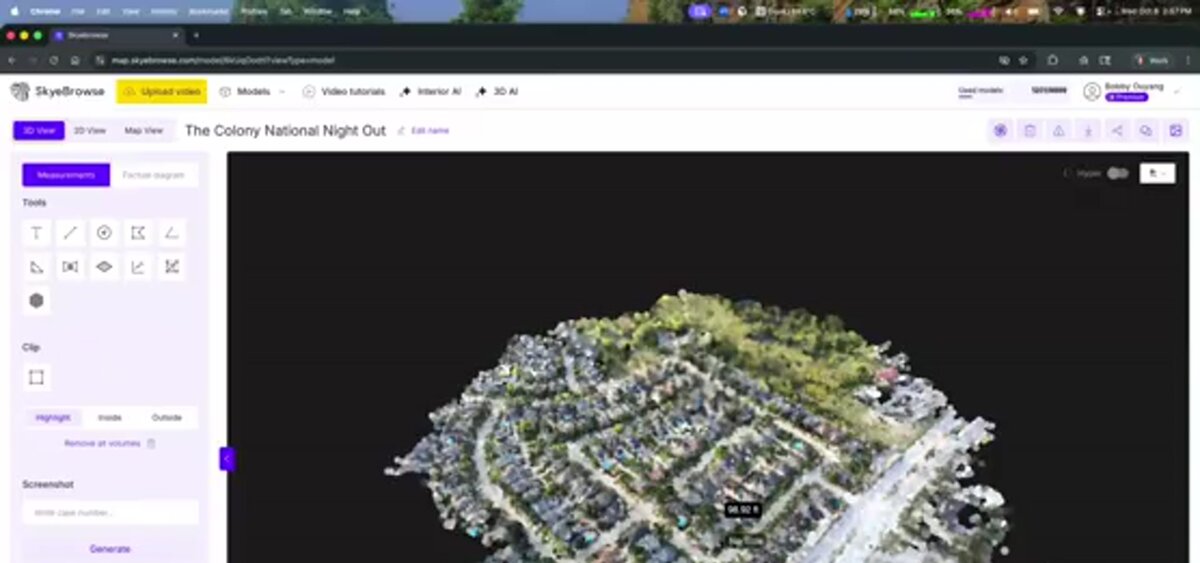
Yes. Video-based platforms like SkyeBrowse accept standard smartphone .MP4 and .MOV recordings through Universal Upload. A 10-to-15-minute walkthrough of a commercial suite, uploaded from any device, returns a measurable 3D model in the cloud within an hour. No dedicated scanning hardware, no specialist operator, and no desktop processing software are required. The free tier is the easiest way to test this with your own space before committing to paid processing credits.
Is there free interior mapping software?
SkyeBrowse offers a free tier with unlimited basic model generation — suitable for 360 virtual tours, rough space documentation, and stakeholder presentations. For measurement-grade output (approximately 0.25-inch accuracy), the Premium tier is $99 per model credit. Polycam also offers a free tier for basic room captures on iOS. Open-source tools like OpenSfM and Meshroom can process photogrammetry locally at no cost, but require technical setup and dedicated GPU hardware that adds friction for most commercial teams.
What is interior mapping software?
Interior mapping software converts video or image captures of a building's interior into measurable 3D models, point clouds, or floor plan outputs. It replaces manual tape-measure sketches and costly laser scanning for applications ranging from facility documentation to insurance loss quantification. Modern cloud-based platforms accept footage from smartphones, action cameras, and 360-degree cameras, returning models accessible from any browser within an hour of upload.
How long does interior mapping take compared to laser scanning?
A video-based walkthrough of a typical commercial suite takes 10 to 15 minutes of capture, with cloud processing returning a 3D model within an hour. Traditional laser scanning requires 30 to 60 minutes per room for setup, multiple scan positions, and equipment relocation — not counting post-processing time on a dedicated workstation. For facilities teams handling routine documentation across a large portfolio, the time difference compounds into hundreds of hours per year.
What file formats does interior mapping software export?
Leading platforms export LAZ point clouds for BIM and CAD import, GLB mesh files for browser-based 3D viewing, and GeoTIFF orthomosaics for GIS integration. Before committing to any platform, verify that its export formats match the downstream tools your team uses — particularly if models will feed into Revit, AutoCAD, ArcGIS, or a facility management system. Platforms that lock outputs into proprietary formats add conversion overhead that accumulates across a large documentation portfolio.